
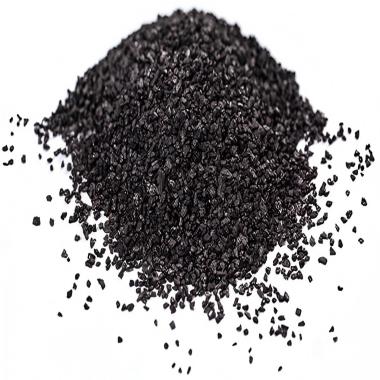
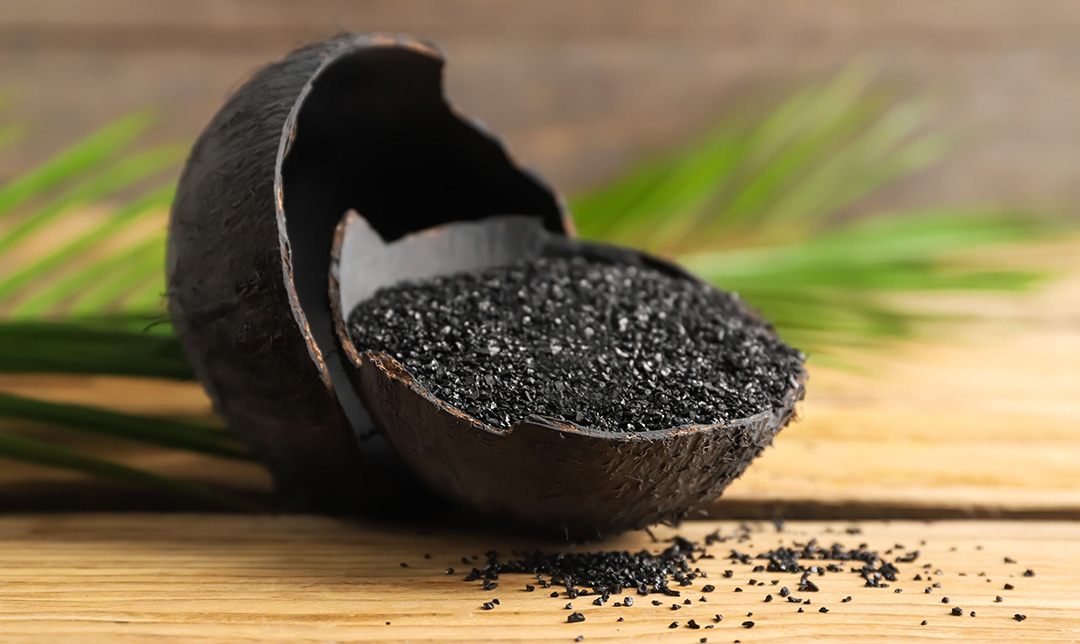
How much gold can one ton of your coconut shell activated carbon absorb?
Release time:
25-11-05
Source:
Excellent question. It gets to the heart of why activated carbon is so crucial in the gold mining industry.
The short answer is: Under ideal industrial conditions, one ton of high-quality coconut shell activated carbon can absorb between 20 kg to 70 kg (44 lbs to 154 lbs) of gold.
However, this is a theoretical maximum under optimized lab conditions. In a real-world mining operation like a Carbon-in-Pulp (CIP) or Carbon-in-Leach (CIL) plant, a more practical and expected loading is in the range of 5 kg to 15 kg (11 lbs to 33 lbs) of gold per ton of carbon.
Let’s break down why there’s such a big range and what factors influence this.
Key Factors Affecting Gold Adsorption
The amount of gold absorbed, often called the “gold loading,” depends on several critical factors:
-
Quality of the Activated Carbon:
-
Hardness & Abrasion Resistance: Coconut shell carbon is prized for its high hardness, which prevents it from turning to dust in aggressive mixing tanks.
-
Pore Structure: The best carbon for gold has a high volume of “mesopores” (pores 2-50 nanometers in size), which are the perfect size for the gold cyanide complex
[Au(CN)₂]⁻to enter and be adsorbed. Coconut shell carbon naturally has a good distribution of these pores.
-
-
Concentration of Gold in Solution (Pregnant Solution):
-
This is the “fuel” for the carbon. A solution with a high gold grade (e.g., 5-10 ppm of gold) will load carbon much faster and to a higher capacity than a lean solution (e.g., 0.5 ppm). The carbon will adsorb gold until it is in equilibrium with the concentration in the solution.
-
-
Competing Ions (Fouling):
-
The process solution isn’t pure. It contains other metals like copper, silver, nickel, and organic compounds (oils, greases, flotation reagents). These can also be adsorbed onto the carbon, “fouling” it and blocking pores that would otherwise be available for gold. This is a major reason why real-world loadings are lower than the theoretical maximum.
-
-
Process Conditions:
-
pH: The adsorption of the gold cyanide complex is most effective in a slightly alkaline environment (pH ~10-11), which is standard in cyanide leach circuits.
-
Temperature: Higher temperatures generally increase the rate of adsorption.
-
Residence Time: How long the carbon is in contact with the gold-bearing solution. Longer contact allows for more complete loading.
-
The Process: How it Works in a Mine
In a typical CIL plant, carbon is placed in a series of large, agitated tanks through which the gold-bearing slurry passes.
-
Fresh or regenerated carbon is added to the last tank (where the solution is most depleted).
-
The carbon moves counter-current to the slurry, gradually being transferred to tanks with richer and richer gold solutions.
-
By the time it reaches the first tank, it is “loaded” with gold and is removed for treatment.
-
This loaded carbon is then sent to a stripping vessel (elution column) where a hot, caustic cyanide solution desorbs the gold, making the carbon barren again so it can be re-used.
-
The gold is then electrowon from the stripped solution and smelted into doré bars.
A Practical Example & Calculation
Let’s assume a realistic, well-managed operation:
-
Carbon Loading: 10 grams of gold per kilogram of carbon (10 g/kg). This is a common and achievable target.
-
Carbon Quantity: 1 metric ton = 1,000 kg.
Calculation:
1,000 kg of carbon × 10 g of Au/kg = 10,000 grams of gold
There are 31.1035 grams in a troy ounce (the standard for precious metals).
10,000 grams / 31.1035 g/ozt = ~321 troy ounces of gold.
So, in this scenario, one ton of your coconut shell activated carbon would hold approximately 10 kg (or 321 troy ounces) of gold before needing to be stripped.
Summary
| Scenario | Approximate Gold Loading per Ton of Carbon |
|---|---|
| Theoretical Maximum | 20 – 70 kg |
| Efficient Real-World Operation | 5 – 15 kg (10 kg / 321 ozt is a good benchmark) |
| Poorly Managed Operation (Fouled Carbon) | Can be as low as 1 – 3 kg |
Conclusion: While high-quality coconut shell activated carbon has a very high potential for gold adsorption, you should base your operational and financial calculations on a more conservative 5 to 15 kg per ton range, with 10 kg being a very robust and common target for effective operations.
CTC
Related News
06-13
2025

Shop 101, No. 202 Huanshi West Road, Yuexiu District, Guangzhou City,Guangdong Province, China
Telephone: 86 13670786666
Mobile: 86 13670786666
E-mail:wuguifang57@gmail.com